If your radiators heat up at different speeds, your home can end up feeling warm in some rooms and chilly in others. Balancing radiators helps by ensuring hot water flows evenly through your heating system, improving comfort and efficiency.
When everything is working in harmony, your home heats up without one room stealing all the warmth, and you’re not playing thermostat roulette trying to find that sweet spot of comfort.
In this guide, we’ll show you how to balance your radiators step-by-step. No waffle, no overcomplicated processes - just straightforward advice from people who know their pipes.
What is balancing radiators all about?
Radiator balancing works by adjusting the valves on each radiator so they all heat up at roughly the same rate. This enables you to control your heating better, giving you optimal comfort across each room in your home.
How can you tell if your radiators are unbalanced?
You’ll probably notice:
-
Some rooms heat up much faster than others.
-
Certain rooms seem to take ages to reach the right temperature.
-
Big temperature differences between rooms.
-
You’re constantly adjusting the thermostat just to feel comfortable.
If that sounds familiar, balancing your radiators could be the fix you’re looking for.
How to balance radiators
Let’s run through the process step by step. But first, here’s what you’ll need to get the job done.
Tools you’ll need:

Step by step guide:
We'll take you through each step in more detail below.
1. Switch off your heating
Might sound obvious, but you’d be surprised how often this step gets overlooked. Your radiators and heated towel rails need to be completely cold before you begin, so go on, switch the heating off and give it time to cool down fully. Then we’ll get down to the nitty gritty.
Oh, and if you’ve recently managed to bleed your radiators - even better. Your temperature readings will be more accurate.
2. Open all your radiator valves
You’ll need: Lockshield valve key (or an adjustable spanner if that’s what you’ve got)
With everything cold, it’s time to open all the radiator valves in your home. Turn each valve anti-clockwise until it’s fully open.
Thermostatic radiator valves and wheelhead valves can usually be turned by hand. Lockshield valves will need their plastic cap removed first. Then use a spanner or lockshield key to open them up.

3. See which radiators heat up fastest
You’ll need: Pencil & paper
Now switch the heating back on and pay attention to which radiators warm up first. These are usually the ones closest to the boiler.
If you’ve got a willing helper (or two), this step gets much easier - extra eyes mean fewer trips up and down the stairs.
4. Let everything cool down again
Once you’ve made your notes, turn the heating off again and let the system cool completely. This can take a while, so some people prefer to leave it overnight - another reason why it’s a good job to tackle before the really cold weather sets in.
5. Turn the heating back on
When all your radiators are fully cold again, turn the heating back on and head straight to the radiator that heated up the fastest earlier. This is the one you’ll adjust first.
6. Adjust the fastest radiator
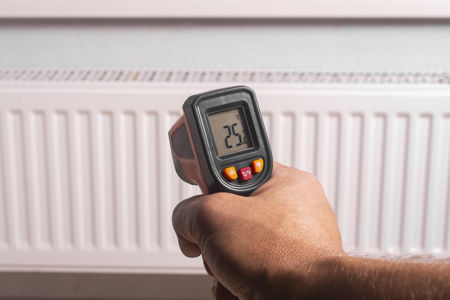
You’ll need: Lockshield valve key or adjustable spanner, digital thermometer or multimeter with thermometer
This is where the fine-tuning begins. Fully close the lockshield valve on this radiator, then open it by a quarter turn.
Once it starts warming up, measure the temperature of the pipe next to the lockshield valve. Then measure the pipe on the opposite side of the radiator, usually near the thermostatic valve.
Slowly adjust the lockshield valve until there’s a 12°C difference between the two readings. Take your time - each small adjustment needs a moment to settle before you measure again.
7. Repeat for the rest of your radiators
You’ll need: Lockshield valve key or adjustable spanner, digital thermometer or multimeter with thermometer
Work through the remaining radiators in the order they warmed up earlier. Slower radiators will usually need their lockshield valves opened a little more.
Radiators furthest from the boiler may need their lockshield valve fully open - and that’s absolutely fine. When you’re done, heat should flow evenly throughout your home, from the closest radiator to the furthest.

Balancing radiators FAQS
If you have some unanswered questions about the process of balancing radiators, these commonly asked questions and answers should help.
1. Why is 12°C the magic number?
A 12°C temperature difference is considered the sweet spot for efficiency when it comes to balancing radiators. It delivers comfortable warmth without pushing your heating system harder than it needs to.
2. What does a lockshield valve do?
A lockshield valve is a small, adjustable valve used to balance the flow of water through a heating device like a radiator or heated towel rail. It controls how much water flows through each radiator so that each one receives the same amount of heat. Adjusting it helps balance heat across your system so every radiator warms up evenly.
3. Can I balance radiators without a thermometer?
Yes, although it’s less precise.
Start with the fastest radiator and open its lockshield valve a quarter turn. Gradually increase the opening for each radiator as they get slower, until the slowest radiator is fully open. Try to spread the adjustments evenly based on how many radiators you have. For example, the first radiator on your list should be opened 25%, the second 30%, the third 40%, and so on until the last radiator is opened 100%.
Still got questions?
Heating can be full of ‘good to know’. If you’re curious about getting the most comfort from your home, our blog is a good place to start. Take a look around, dip in where it suits you, and come back whenever you need a little more warmth and guidance!
Why not try: Which radiators are best for bathrooms?; Should you turn your thermostat up when it’s cold?; and Why is my radiator making noise?.
Balancing your radiators may have highlighted some rooms that could use a little extra help. If it’s time to explore your options, view our full ranges of radiators, heated towel rails and underfloor heating.