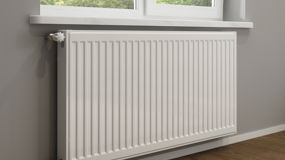
If you’re comparing heat outputs, weighing up panel types and wondering what those “Type 11” numbers actually mean, you’re in the right place. Convector radiators are one of the most popular choices in UK homes – and for good reason. They’re designed to maximise heat using clever internal fins, helping warm air circulate faster and more efficiently around your space.
Here’s everything you need to know before choosing one.
Flat panel radiators: the starting point
At its simplest, a radiator is a hollow metal panel that fills with hot water when your central heating switches on. The metal heats up and warmth is released into the room.
A flat panel radiator is the most straightforward version of this. Slim, rectangular and minimal in design, it’s essentially a heated metal tank. It still warms a room through a combination of radiation and natural air movement, but it doesn’t actively enhance airflow.
If you’re working with limited wall depth or want a clean, low-profile look, flat panel styles are a brilliant, understated option.
What is convection heating?
Convection is simply the natural movement of warm air.
Cool air sinks to the bottom of a room. As it passes through the bottom of a radiator, it heats up, rises, and spreads across the space. That air eventually cools, drops again, and the cycle continues.
All radiators rely on this principle to some degree. Convector radiators just supercharge it. Their internal fins are designed to funnel rising air upwards more efficiently, helping rooms warm up faster and more evenly.
What makes a convector radiator different?
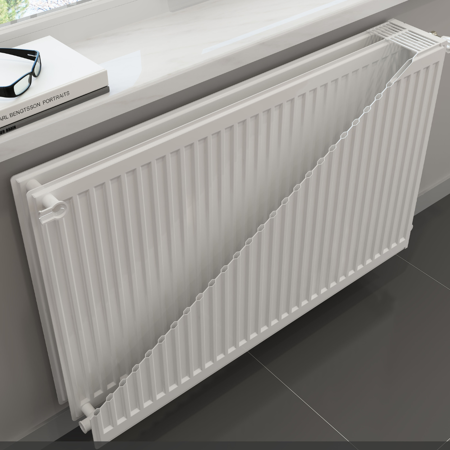
A convector radiator takes that flat panel concept and adds a clever upgrade: metal fins fixed between (or behind) the panels.
These zig-zag fins dramatically increase the surface area inside the radiator. More surface area means more heat transfer. As cool air is drawn in at the bottom, it’s heated quickly and pushed upwards, creating a continuous flow of warm air through the room.
In short? Same footprint on the wall, noticeably higher heat output.
Convector radiators vs standard radiators
Every radiator both radiates heat sideways and warms air through convection. The difference is emphasis.
- Standard flat panels allow convection to happen naturally.
- Convector radiators are specifically engineered to encourage stronger airflow and increase heat output.
If you like standing right next to your radiator, you’ll still feel that direct warmth. But if you’re heating a larger room and want consistent temperature throughout, convector styles tend to distribute heat more effectively.
Put simply: more fins = more surface area = more BTUs.
Types of convector radiator explained
(For clarity, we’re assuming equal width and height across each type — the key difference is panels and fin layers.)
Type 11 – Single panel convector (K1)
Also known as K1 or Type 11, this is a single front panel with one layer of convector fins attached at the back.
Compared to a standard single panel (Type 10), it delivers significantly more heat output for the same width and height. It’s slightly deeper, but still relatively slim.
Best for: Small rooms, hallways and spaces where you want a balance of profile and performance.
Type 21 – Double panel plus convector (P+)
Type 21 radiators feature two panels with a single layer of fins between them.
You get a noticeable jump in heat output compared to Type 11, while still keeping a relatively manageable depth.
Best for: Bedrooms and mid-sized rooms that need a bit more warmth without going ultra-deep.
Type 22 – Double panel convector (K2)
One of the most popular options in UK homes. Two panels. Two layers of fins. Plenty of output.
Each panel has its own fin layer, creating a substantial internal surface area and a strong convection cycle.
Best for: Medium to large rooms where reliable, consistent heat is essential.
Type 33 – Triple panel convector
Type 33 radiators have three panels with three layers of fins, providing maximum heat output. They are significantly deeper but deliver serious output. If wall width is limited but you need higher BTUs, increasing depth is often the smartest solution.
Best for: Large spaces, open-plan areas or rooms with higher heat demand.
How to choose the right convector radiator
Start with heat requirements. The size of your room, ceiling height, window area and insulation levels all influence how many BTUs you’ll need.
Once you know your required output:
- Tight on depth? Consider Type 11.
- Need more power in a similar width? Step up to Type 21 or 22.
- Heating a large space with limited wall width? Type 33 could be the answer.
Getting the BTU calculation right is essential - too little and your room never feels warm enough, too much and you’re overspending. A quick calculation before buying makes all the difference.
Browse our full range of convector radiators.